

Real Estate Solar Reports
Solar is an Asset.Assuming it's on.
Selling, that's a case you have to make. Buying, it's a risk you have to check. Either way, we tell you in writing what the system is actually doing, what it's worth, and what it costs to fix anything we find.
Documentation Review in 72 hours · On-Site Inspection in about a week · anywhere in the country
The house has solar. Who knows if it works?
So somebody should go and find out. The report covers the same ground whichever side you're on — we just lead with what matters to your side of the table.
I'm a Realtor
Get the details for your listings, or order a report on behalf of a client. Co-branded with your name and brokerage at no extra cost.
Realtor optionsI'm Selling a Home
Find out what the system is worth, what needs fixing before you list, and what you'll need to disclose — on your terms, not a buyer's inspector's.
Order a seller reportI'm Buying a Home
Find out what you're actually inheriting: whether it produces, what it costs to fix, who holds the loan or lease, and what transfers to you.
Order a buyer reportEvery house with solar has numbers attached
Eight things we go and determine about this specific system — together, they're how we arrive at them.
- Whether the system is producing
- The central question. On an On-Site Inspection we measure it. On a Documentation Review we report what the records show and say plainly that we did not test it.
- Electrical readings, and what they mean
- Voltages, currents, and inverter status — with a plain-English reading of whether those numbers are normal for this equipment.
- Array and roof condition
- Panel condition, mounting and penetrations, visible wear, shading, and anything about the roof itself that affects the solar.
- Monitoring and communication status
- Whether the system is reporting to the manufacturer at all, how long it has been offline if it is, and whether the monitoring account can transfer.
- Warranty and transferability
- What coverage is on record for the equipment and the workmanship, how long it runs, and what has to happen for it to follow the house.
- Loan, lease, and PPA obligations
- What kind of agreement is on the system, who the finance company is, and what typically has to happen before closing. As reported by the customer — we do not review the contract.
- Estimated production and value
- What the system should produce for this house on this roof, and what that is worth at the local utility rate. An estimate, not an appraisal.
- Cost to correct anything found
- Every problem comes with a number. Take it to us or take it to anyone else — the point is that the deal has a figure to work with.
Two ways to get it done
These are not tiers of the same service. They answer different questions — pick the one that matches yours.
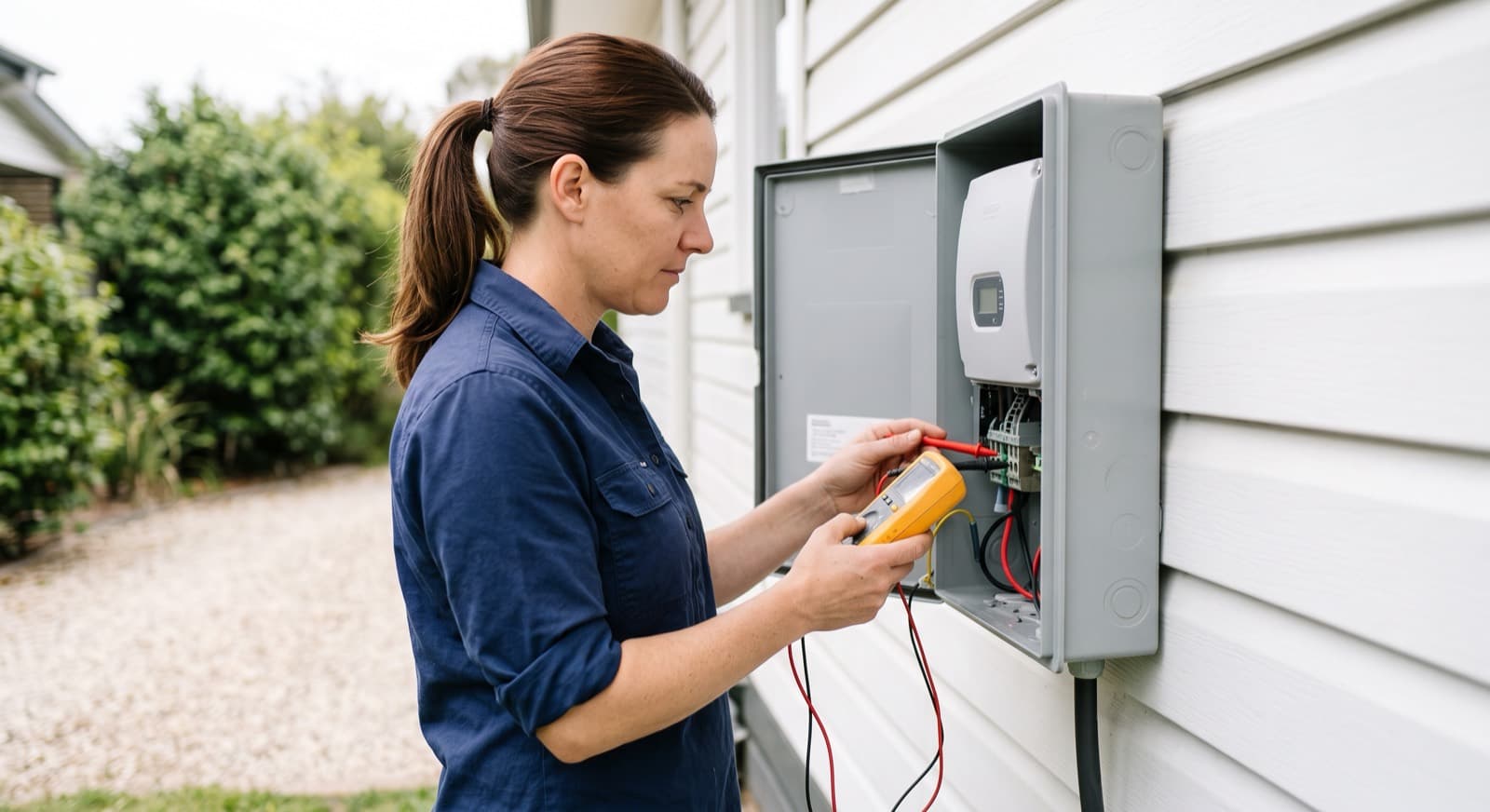
On-Site Inspection
$249Answers “does it work?”
A technician goes to the property, performs electrical testing at the equipment, inspects the array and roof, and photographs the system. Where there is no monitoring access to read, this is the only way we can confirm a system is actually producing power.
- Live electrical readings taken at the equipment
- Array, mounting, and roof penetration inspection
- Full photo record of what the technician found
- Everything in the Documentation Review as well
Turnaround: about one week from receipt of materials — a technician visit has to be scheduled.
Start an On-Site Inspection
Documentation Review
$199Answers “what do the records say?”
You send photos and paperwork; we review the monitoring history, warranty registrations, interconnection documents, production data, and what you've told us about the agreement on the system. No technician visit and no electrical testing.
- Monitoring and production history reviewed
- Warranty coverage and transferability
- Interconnection and utility rate review
- Ownership and obligations, as reported by the customer
Turnaround: 72 hours from receipt of your photos and materials.
Start a Documentation ReviewHow long it takes
- Documentation Review
- 72 hours from receipt of your photos and materials.
- On-Site Inspection
- about one week, wherever the property is — a technician visit has to be scheduled with whoever controls access to it.
The clock starts when we have what we need — not when the payment clears. If something on the checklist is missing, the clock starts when the missing item arrives. You will see a running list of what is still outstanding, so it is never a mystery why a report hasn't moved.
See one first
Here is a real report with the property details redacted, so you can see the format, the level of detail, and how findings and costs are presented before you order.
Sample report coming shortly — call (706) 204-9115 and we'll walk you through one.
Questions people actually ask
Tap any question to expand the answer.
The basics
What is a real estate solar report?
It's a written evaluation of the solar system on a specific house, done for a sale. We determine whether the system is actually producing power, what condition the equipment and roof are in, what warranties are left and whether they transfer, what the monitoring situation is, and what it would cost to fix anything we find. You get a document you can hand to the other side of the deal.
How is this different from a home inspection?
A home inspector looks at the whole house and, in our experience, gives solar a paragraph — usually 'solar panels present, recommend evaluation by a qualified specialist.' That sentence is what sends people to us. We only look at the solar, we test it electrically when we're on site, and we can tell you what the readings mean.
Do you have to visit the property?
Not always. An On-Site Inspection means a technician goes out, takes electrical readings, and photographs the system. A Documentation Review is done from photos and paperwork you send us. Only the on-site visit can confirm the system actually works — see the next question.
What's the difference between an On-Site Inspection and a Documentation Review?
An On-Site Inspection is the one that answers 'does this thing work.' A technician measures voltages and currents at the equipment, inspects the array and the roof penetrations, and photographs what they find. A Documentation Review is a records review — we read the monitoring history, warranty registrations, interconnection paperwork, and production data you provide, and tell you what they say. Without full monitoring access it cannot confirm that the system produces power, because nobody put a meter on it. With portal access it can — the production history answers that question directly. So it's the right choice when monitoring access or history already exists, or when your question is about paperwork rather than equipment.
Timing and access
How fast can I get it?
A Documentation Review is 72 hours from when we have your photos and materials. An On-Site Inspection is about a week, because a technician has to be scheduled out to the property. The clock starts when we receive the materials, not when the payment clears — and if something is missing, it starts when the missing item arrives. We'll show you exactly what's still outstanding.
I'm the buyer — can you inspect a house I don't own yet?
Yes, and most of our buyer orders are exactly that. You'll need the seller's permission for us to enter the property, and getting that permission is on you or your agent — usually your agent arranges it the same way they arrange the home inspection. Everything else we handle.
My system is Enphase. Why do you need monitoring access before you can help?
Honestly: some equipment can be read on site and some can't. With SolarEdge or Tesla, a technician can connect to the inverter at the house and take real readings. Enphase microinverters don't work that way — the meaningful data only exists in the manufacturer's portal, and without access to it we'd be handing you photographs and guesses. So for Enphase we ask for portal access up front, and if it can't be obtained we refund you in full, at any stage. We're not going to take money for a report we can't write.
What happens to monitoring after closing?
We ask every customer for monitoring access, on every order, because it makes the report better and because it's usually the first time anyone has looked at the system in years. When access is established we start 30 days of complimentary Pro monitoring — from the day access actually works, not from the day you paid. Buyers usually can't grant access to a house they don't own yet, so the offer stays open and we bring it up again after you move in. When the 30 days are up you move to Basic, which is free and stays free — we keep visibility into the system so we can help if you call, but we stop sending you alerts. Nothing is charged unless you choose a paid plan.
Money, contracts, and the deal
I'm selling. Will this report create something I have to disclose?
Probably, yes — and that's the honest answer rather than the comfortable one. In most states, once a seller knows about a material defect, they generally have to disclose it — your agent or attorney can tell you exactly how it works where you are. If we find a problem, you'll know about it. What that buys you is control: you can fix it, price it in, or disclose it on your own terms before a buyer's inspector finds it during due diligence and turns it into a renegotiation. Finding out at the closing table is the expensive version.
What if the system is leased or has a loan?
We'll explain what it generally means for the deal — who typically has to approve a buyer, what usually has to happen before closing, what questions to ask. What we don't do is read your contract. We don't collect financing agreements at all. We ask you four questions (who the finance company is, roughly what you pay, what the payoff is if you know it, and what kind of agreement it is), we label all of that as customer-reported and unverified in the report, and we point you at the finance company for the actual terms and payoff figure. They're the only ones who can give you a number you can rely on.
Can the report tell me what the solar is worth?
We give an estimate of production value based on what the system produces and what your utility pays for it. That's an estimate, not an appraisal and not a guarantee. If you need a number that carries weight with a lender, that's an appraiser's job, and the report gives them something real to work from.
What if the deal falls through?
If you cancel before we've scheduled anything or reviewed your materials, you get a full refund. If a technician has already gone out and couldn't get in, we keep a trip fee based on how far they drove, or you get one free reschedule. If the work is already done, the price stands — the report is yours to use on the next buyer. And if the system is Enphase and portal access can't be obtained, you get everything back regardless of how far along we are.
After the report
Who owns the report — can my agent share it?
You bought it, you can share it. Send it to your agent, the other side, your lender, whoever it's useful to. The report carries its own scope and disclaimer language so anyone reading it knows what it does and doesn't cover.
Do you service the system if we find problems?
Yes. Southern Solar Pro has been doing solar service in this area for over ten years, and we're certified across the major equipment brands. Every finding in the report comes with what it would cost to correct, and you're welcome to take that number and hire anyone you like — there's no obligation to use us.
Asset or liability. Find out which.
Wherever the property is, and whether you're listing, buying, or representing someone who is — a few hundred dollars now is cheaper than finding out at the closing table.
Questions? info@southernsolarpro.com